Joel Mokyr
| Joel Mokyr | ||
|---|---|---|
 | ||
| Persoonlijke gegevens | ||
| Geboortedatum | 26 juli 1946 | |
| Geboorteplaats | Leiden | |
| Beroep | economisch historicus, academisch docent, econoom | |
| Lid van | Accademia Nazionale dei Lincei, American Academy of Arts and Sciences, Koninklijke Nederlandse Akademie van Wetenschappen, Econometric Society | |
| Academische achtergrond | ||
| Alma mater | Hebreeuwse Universiteit van Jeruzalem,[1] Yale-universiteit | |
| Promotor(s) | John Ching-Han Fei,[2] William N. Parker[2] | |
| Wetenschappelijk werk | ||
| Vakgebied(en) | economische geschiedenis | |
| Prijzen en erkenningen | Guggenheim-lidmaatschap (1980), Balzanprijs (2015), Dr A.H. Heinekenprijs voor geschiedenis (2006), lid van de Econometric Society (2011), Lid van de American Academy of Arts and Sciences, Clarivate Citation Laureates (2021),[3] honorary doctorate from University of Lyon-II (16 november 2023),[4] Prijs van de Zweedse Rijksbank voor economie (2025) | |
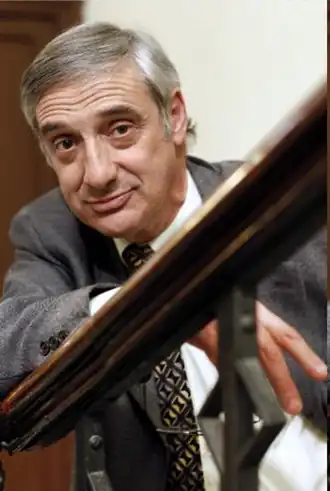
Joel Michael Mokyr [5] (Leiden, 26 juli 1946 [6]) is een Amerikaans en Israëlisch economisch historicus die hoogleraar economie en geschiedenis was aan Northwestern University in de Verenigde Staten.[7] Hij was daarnaast ook Sackler Professorial Fellow aan de Eitan Berglas School of Economics aan de Universiteit van Tel Aviv. [7] In 2025 ontving hij de Nobelprijs voor de Economie (gedeeld) "omdat hij de voorwaarden voor duurzame groei door technologische vooruitgang heeft geïdentificeerd."[8][9]
Jeugd en carrière
Hij werd als Joel Michael Mok in 1946 geboren in Leiden[10][8] in een familie van Nederlandse Joden die de Holocaust hadden overleefd.[11] Zijn vader Salomon Mok, namens de SDAP gemeenteraadslid van Amsterdam, voorzitter van de Raad van Arbeid in Leiden en Utrecht en docent rechten aan de Universiteit Leiden,[12] stierf aan kanker toen hij één jaar oud was.[11] Hij emigreerde als kind naar Israël met zijn moeder, Gonda Mok (geboren Jakobs) en zuster, [5] en groeide op in Haifa onder de naam Mokyr.[11] Zijn oudere broer Rob Mok bleef in Nederland. Hij behaalde een BA in economie en geschiedenis aan de Hebreeuwse Universiteit van Jeruzalem in 1968.[13] Daarna behaalde hij een M.Phil. in economie aan Yale University in 1972,[13] gevolgd door een Ph.D. in de economie aldaar in 1974.[13] Zijn proefschrift was getiteld: Industriële groei en stagnatie in de Lage Landen, 1800-1850.[14]
Eerbetonen
Mokyr werd in 1996 verkozen tot lid van de American Academy of Arts and Sciences en in 2011 tot Fellow van de Econometric Society.[15] [16] In 2001 werd hij verkozen tot buitenlands lid van de Koninklijke Nederlandse Akademie van Wetenschappen, waarvan hij in 2006 de tweejaarlijkse Dr. A.H. Heinekenprijs voor Geschiedenis ontving.[17][18] Hij won in 2015 de Balzan International Prize voor economische geschiedenis.[19] In 2025 werd hem de helft van de Nobelprijs voor de Economie toegekend "omdat hij de voorwaarden voor duurzame groei door technologische vooruitgang heeft geïdentificeerd", terwijl de andere helft naar Philippe Aghion en Peter Howitt ging.[8]
Persoonlijk
Mokyr is getrouwd met Margalit Birnbaum, hoogleraar biochemie en moleculaire biologie aan de Universiteit van Illinois in Chicago.[20] Ze hebben twee dochters.[5]
Bibliografie
- Mokyr, Joel (1976). Industrialization in the Low Countries, 1795-1850. Yale University Press. ISBN 978-0-300-01892-9.
- Mokyr, Joel (1985). Why Ireland Starved. Unwin Hyman. ISBN 978-0-04-941014-5. Revised edition.
- The Economics of the Industrial Revolution. Rowman & Littlefield Publishers (1989). ISBN 978-0-86598-148-5.
- Mokyr, Joel (1990). Twenty Five Centuries of Technological Change: An Historical Survey. Taylor & Francis. ISBN 978-3-7186-4936-5.
- The Vital One: Essays in Honor of Jonathan Hughes. JAI Press(NY) (1991). ISBN 978-1-55938-150-5.
- Mokyr, Joel (1992). The lever of riches: technological creativity and economic progress. Oxford Univ. Press. ISBN 978-0-19-506113-0.
- The British Industrial Revolution: an Economic Perspective. Westview Press (1998). ISBN 0-8133-3389-X. Revised edition.
- The Gifts of Athena: Historical Origins of the Knowledge Economy. Princeton University Press (2002). ISBN 978-0-691-09483-0.
- The Oxford Encyclopedia of Economic History. Oxford University Press (2003). ISBN 978-0-19-510507-0.
- The Oxford Encyclopedia of Economic History: Accounting and bookkeeping - Contract labor and the indenture system. Oxford Univ. Press (2003). ISBN 978-0-19-517090-0.
- The Oxford Encyclopedia of Economic History: Cooperative agriculture and farmer cooperatives - Hughes, Jonathan. Oxford Univ. Press (2003). ISBN 978-0-19-517091-7.
- The Oxford Encyclopedia of Economic History: Monte di Pietà - Spain. Oxford Univ. Press (2003). ISBN 978-0-19-517093-1.
- The Oxford Encyclopedia of Economic History:Slavery, U.S. to Unions, Labor. Oxford University Press (2003).
- The Oxford Encyclopedia of Economic History: Spices and spice trade, Zoos and other animal parks, Index. Oxford Univ. Press (2003). ISBN 978-0-19-517094-8.
- Mokyr, Joel (2009). The Enlightened Economy: An Economic History of Britain 1700-1850. Penguin Books Ltd. ISBN 978-0-300-18951-3.
- Landes, David S. (2010). The Invention of Enterprise: Entrepreneurship from Ancient Mesopotamia to Modern Times. Princeton University Press. ISBN 978-0-691-14370-5.
- Cruz, Laura (2010). The Birth of Modern Europe: Culture and Economy, 1400-1800. BRILL. ISBN 978-90-04-18934-8.
- Mokyr, Joel (2016). A Culture of Growth: Origins of the Modern Economy. Princeton University Press. ISBN 978-0-691-16888-3.
- (he) Ofer, Anita (2017). Economics in the Test of Time: Issues in Economic History. Open University of Israel Press. ISBN 9789650615475. ISBN 9789650615505. Two volumes.
- Greif, Avner (4 november 2025). Two Paths to Prosperity: Culture and Institutions in Europe and China, 1200-2000. Princeton University Press. ISBN 978-0-691-26594-0.
 ·
·  ·
· 
- ↑ https://news.northwestern.edu/stories/2025/10/joel-mokyr-wins-nobel-prize-in-economics.
- 1 2 Mathematics Genealogy Project.
- ↑ https://clarivate.com/citation-laureates; geraadpleegd op: 23 september 2023.
- ↑ https://www.univ-lyon2.fr/universite/bourses-prix-et-distinctions/dhc.
- 1 2 3 Joel Michael Mokyr. www.dutchjewry.org. Geraadpleegd op 14 oktober 2025.
- ↑ Joel Mokyr. Nobel Foundation.
- 1 2 (en) Joel Mokyr. Beloit College. Geraadpleegd op 13 oktober 2025.
- 1 2 3 The Prize in Economic Sciences 2025. The Royal Swedish Academy of Sciences (13 October 2025).
- ↑ Milo van Bokkum, Met de Nobelprijswinnaar op pad. ‘Ik spreek het Nederlands van een jongetje in de jaren 50’. Interview Joel Mokyr Winnaar Nobelprijs voor Economie, NRC 22 november 2025, blz. E16-19.
- ↑ Burgelijke Stand, Leidsche Courant, 29 juli 1946 via Historische Kranten, Erfgoed Leiden en Omstreken
- 1 2 3 Aeppel, Timothy, "Economists Debate: Has All the Important Stuff Already Been Invented?", Wall Street Journal. Geraadpleegd op 12 January 2017.
- ↑ Familiebericht. "Algemeen Handelsblad". Amsterdam, 25-02-1948. Geraadpleegd op Delpher op 16-10-2025, https://resolver.kb.nl/resolve?urn=KBNRC01:000045885:mpeg21:p002
- 1 2 3 (en) Joel Mokyr wins Nobel Prize in Economic Sciences. news.northwestern.edu. Geraadpleegd op 14 oktober 2025.
- ↑ Mokyr, Joel (1974). Industrial Growth and Stagnation in the Low Countries, 1800-1850.
- ↑ Member Directory | American Academy of Arts and Sciences. www.amacad.org. Geraadpleegd op 23 januari 2024.
- ↑ (en) Current Fellows. www.econometricsociety.org. Geraadpleegd op 23 januari 2024.
- ↑ Joël Mokyr. Royal Netherlands Academy of Arts and Sciences. Gearchiveerd op 13 February 2016. Geraadpleegd op 13 February 2016.
- ↑ Joel Mokyr (1946), USA. Royal Netherlands Academy of Arts and Sciences. Gearchiveerd op 22 July 2020.
- ↑ Joel Mokyr. Northwestern University. Geraadpleegd op 27 January 2018.
- ↑ (en) Cahan, Richard, Joel Mokyr becomes Northwestern's fourth Nobel laureate. Evanston RoundTable (14 oktober 2025). Geraadpleegd op 14 oktober 2025.